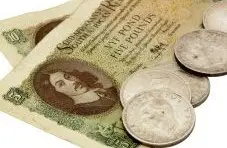
Most of us check a price in rand without thinking twice about it. You'll find the same currency on the board at the petrol station, in the total of a Takealot cart and on the till slip at Checkers, and every one of those prices divides into 100 cents. That arrangement is younger than plenty of houses in this country, and the day it started is a cracking story about how Mzansi came to count its money.
We apply that same thinking to every screen you open here at Springbok Casino. As a ZAR online casino, we count every deposit, balance and payout in rand, and we never convert your money into dollars along the way. The figure you see on the game is the figure at our cashier, and it's the one your own bank will show you afterwards. Deposits, balances and payouts are counted in that one unit, whichever game you open.
Before we get to that cashier, there's the small business of how the pound disappeared here in a single day, and what R1 covered at the till back then. The tickey outlived the pound by four years, since that coin stayed in circulation until 1965. A single rand covered eleven loaves of bread in 1961, and we still count every wager at this ZAR online casino in that same unit. First the history, Bokke, then our cashier!
How South Africa Changed from Pounds to Rand in a Single Day
On 14 February 1961, South Africa stopped counting in pounds, shillings and pence and started counting in rand and cents. One pound converted to R2, one shilling to 10c, and the tickey - that little threepence - converted to 2½c. The Decimal Coinage Commission had recommended the change three years earlier, which gave the banks, the shops and the Mint a good long while to prepare for the swap.
The name for the new currency came off the Witwatersrand, the gold-bearing ridge where Johannesburg was built, so we ended up with money named after a reef of rock. A currency named after the ground it came out of beats one named after a monarch! The timing was a statement of intent too, since decimalisation happened three months before the republic was declared, and from that day the gold country's name appeared on every note in circulation.
That first set of coins covered a half-cent up to 50c, with a 1c, 2½c, 5c, 10c and 20c in between, and the first notes were issued as R1, R2, R10 and R20. The face on those notes was taken for Jan van Riebeeck for decades, until the portrait was identified as a Dutchman by the name of Bartholomeus Vermuyden. Mzansi spent years paying with the wrong oke's face, and the mistake went undetected for decades!
The first series lasted until 1965, when the 2½c was withdrawn in favour of a 2c and the coat of arms replaced that portrait on the coins entirely. South Africans went on saying tickey long after they had stopped handling the coin, and most of us still know exactly what the word means. That is how slowly money habits change in this country… The prices on the tickets rose a great deal faster than the habits did, though, and we'll get back to that.
Q: What replaced pounds, shillings and pence in South Africa?
A: Rand and cents, from 14 February 1961. One pound converted to R2 and one shilling to 10c, so a ten-shilling ticket became R1 overnight, and a penny became slightly less than 1c. The tickey converted to 2½c and stayed in circulation until 1965, when a 2c coin took its place. Every note and coin issued in this country since that day has been denominated in rand, at a fixed 2 to 1 against the old pound.
Decimal Dan & the Campaign That Taught Mzansi to Count in Cents
Changing a country's money takes a great deal more than a notice in the gazette, which is why the government paired the changeover with a cartoon figure called Decimal Dan, the rand-cent man. He appeared on 14 February 1961 in English, in Afrikaans as Daan Desimaal and in South West Africa as Dan Dezimal, doing the same job in three languages at once. Not bad for a drawing with no salary to speak of!
Dan had help, and plenty of it. About three million flyers were put up on notice boards in banks, parks and post offices, each one showing shoppers what their shillings converted to, and the campaign appeared in the press for the mense who never went near a bank. Eish, imagine the queue at the post office that week! We rate the whole exercise a smarter piece of work than most banking apps manage today.
That mixture of a real explanation and a friendly face is how we'd introduce any money system, ours included. Open the cashier here at Springbok Casino and you'll find the minimum and maximum for every method quoted in rand, before you commit a single cent to anything. Every figure at this ZAR online casino is already quoted in rand, from the smallest deposit to the largest payout we process. Decimal Dan would have approved of ours, we reckon!
Q: How did shopkeepers learn to price goods in cents?
A: Through a national campaign built around Decimal Dan, the rand-cent man. Roughly three million flyers went up in banks, parks and post offices with the conversion tables on them, and the same character appeared in Afrikaans as Daan Desimaal and in South West Africa as Dan Dezimal. The campaign also featured in the press, so South Africans well outside the banking halls learned the new sums too.
The Price of a Loaf, Then & Now - The Rand's Purchasing Power
Prices in this country have risen almost 97 times since 1961, according to Stats SA's figures. A basket of goods costing R100 in 1961 came to nearly R9,700 by 2020, which is R9,600 added to the same trolley of shopping. The rand itself didn't shrink over those decades, since the prices on the tickets rose around it, one budget speech at a time. Sixty years of inflation does that to a currency, whichever unit you happen to count in.
We'd rather show you three ordinary items than quote an index at you, and all three are taken from that same Stats SA comparison. Have a look at what each one cost in 1961, set against what the identical item cost in 2020, with no inflation adjustment applied to either figure. Those two columns are the clearest way to weigh up how far the purchasing power of a single rand has shifted in sixty years, and the chicken is the one that surprised us:
- A loaf of bread cost 9c in 1961 and R15.21 in 2020.
- A kilogram of chicken cost 70c in 1961 and R58.09 in 2020.
- A dozen eggs cost 34c in 1961 and R37.60 in 2020.
Nine cents for a loaf? Ja, really - that is what the till took in 1961, and your ouma would have got a cent back from a 10c piece. What hasn't changed in all that time is the unit those prices are counted in, which is the same one behind every game we offer. The figure in front of you is in rand, whether it belongs to a loaf, a lotto ticket or a spin in our Springbok Casino lobby, and we never ask you to convert it at any stage.
Q: How much more does the same basket of goods cost now than in 1961?
A: Almost 97 times more, according to Stats SA's figures. R100 of groceries in 1961 came to roughly R9,700 by 2020, and you'll find the same shift in single items: bread at 9c against R15.21, chicken at 70c a kilogram against R58.09, and eggs at 34c a dozen against R37.60. The unit itself hasn't changed since decimalisation, so a 1961 price can be compared directly against a modern one.
Fast-Forward to 2026 & the Bigger Eish - What Bread, Chicken & Eggs Cost Now
Those 2020 figures are out of date already, mense, since the six years after them added another round of increases. Stats SA put a loaf at R15.21 in 2020, while the urban average in May 2026 is R19.61, and a branded Sasko, Albany or Blue Ribbon loaf costs upwards of R20. Ask for rye or sourdough and you're in another price bracket altogether… One projection puts that same white loaf at R45 by 2036, so good luck to you, and to your bank account!
Chicken and eggs make that loaf look tame, so which comes first here, the chicken or the egg? Let's go chicken. Depending on what you put in the trolley, you're looking at roughly R80 a kilo, and free-range breast fillets from Woolies cost about R170 a kilo. Even by Woolies standards, that is a jump of about R70 in five or six years, on a shelf where a two-kilogram bag of frozen mixed portions is R89.99. Shocking, nê?
Now for the eggs… Do you remember the avian flu outbreak that cost this country millions of layer hens? A regular egg may as well have come from the golden goose by the looks of the prices since. We paid less than forty bucks for a dozen in 2020, and that same dozen came to roughly R46.66 in January 2026. What sets our ZAR online casino apart from all of that is that a R0.25 bet in the Springbok Casino lobby stays a R0.25 bet until YOU decide to change it!
Your Money Stays in Rand at a ZAR Online Casino Like Springbok
Every amount here at Springbok Casino is quoted, wagered and paid in South African rand, from the R35 minimum on BetterEFT to the R25,000 ceiling on a single withdrawal request. We're a .co.za operation built for this market alone, which is why you'll never do currency sums before working out what a spin costs you. The figures at a ZAR online casino like ours are set in the unit you already think in, and the dollar stays out of it entirely.
Most of us have paid a conversion margin at some point without ever seeing it itemised, since that margin is taken inside the exchange rate itself. At a ZAR online casino, there is no exchange rate anywhere in the chain: R500 deposited is R500 in your balance, and R500 withdrawn is R500 in your bank account. Your own bank may still charge its standard EFT fee, and that one is between you and them.
Alongside the currency, banking at Springbok Casino is protected by Secure SSL Encryption, and verification is carried out in line with FICA before any payout is processed. Verification is the least entertaining screen in our cashier, and it is why we pay into the right person's account and no one else's. Live and personalised offers appear in your account inbox in rand too, so there's nothing to convert before you decide what to do with one.
The rand is traded a great deal further afield than our own borders. It's the 18th most traded currency in the world, nogal, with a daily turnover of roughly $72 billion on the Bank for International Settlements' three-yearly count. That is a fair amount of trade for a currency from the bottom of Africa. We'd rather count a ZAR online casino balance in that unit than dress our lobby up in dollars for the sake of appearances!
Q: Which currency are my winnings paid in?
A: South African rand, every time. A wire transfer is paid into a South African bank account in ZAR, from R500 up to R25,000 per request, with no fee from our side and no conversion at either end. Play at our ZAR online casino is exclusively in rand, so the figure in your Springbok Casino balance is the figure you request at the cashier, and the same one your bank receives.
Instant EFT, Cards or a Cash Voucher - Funding in Rand at Springbok
The smallest rand deposit at our cashier is R35 through BetterEFT, and the largest single one is R100,000 through EFTpay or InstantEFT. Cards work between R150 and R2,000, and CashToCode covers R200 up to R3,500. Those five methods are every one of them quoted in rand, each with its own ceiling to suit a different size of bankroll at this ZAR online casino, and each one is credited instantly or near-instantly.
Which EFT option is open to you depends on where you bank. BetterEFT at Springbok Casino accepts Absa, African Bank, Bidvest, Capitec, FNB, Investec, Nedbank, Old Mutual, Standard Bank and TymeBank. EFTpay and InstantEFT both work with Absa, FNB, Nedbank, Bidvest, Investec, TymeBank and Old Mutual, which means any Capitec client can go straight to BetterEFT, credited the moment they confirm the payment.
Two of those methods are the pair most of us weigh up when funding a ZAR online casino account, since the two of them were built for completely different circumstances. The first one works through your internet banking login, the second through cash at a retail till, so the pair between them covers a bank transfer and a cash payment. Have a look at the two of them side by side, with the rand figures our cashier applies to each:
|
Feature |
BetterEFT |
CashToCode |
|
Minimum deposit |
R35 |
R200 |
|
Maximum deposit |
R65,000 |
R3,500 |
|
How the payment is made |
Log in to your bank and approve the transfer |
Buy an eVoucher code, or scan a QR code at a partner outlet |
The EFT side of that table takes all of five steps at our cashier, and every one of them happens inside your own banking login. You pick your bank, you approve the payment, and we credit the funds to your Springbok Casino account while you're still looking at the confirmation screen. Run through the sequence once and it stays in your kop for the next time you top up, whichever of the three EFT options your bank supports:
- Choose the EFT method in the cashier.
- Select your bank from the list.
- Log in securely to your bank through the provider's system.
- Approve the payment.
- The funds are credited to your casino account instantly or near-instantly.
The whole business takes about as long as buying prepaid electricity from the same banking app. Have you ever waited days on a payment to clear? There is no such wait here, since money moving through a single transfer stays in rand the entire way, which keeps your bank statement and your Springbok Casino balance identical to the last cent. For a country that once needed a cartoon oke to explain 10c, five steps and an instant credit is not bad going!
Q: Which deposit method works if I bank with Capitec?
A: BetterEFT, which does accept Capitec. The minimum is R35 and the maximum R65,000, credited immediately once you confirm the payment at your bank, with your bank's standard EFT fee the only extra. EFTpay and InstantEFT support Absa, FNB, Nedbank, Investec, Bidvest, TymeBank and Old Mutual, so Capitec clients fund a Springbok Casino account through BetterEFT instead.
Q: Can I fund an account without internet banking?
A: Yes, through CashToCode, from R200 up to R3,500 a deposit. The eVoucher version emails you a digital code that's redeemable immediately, and the Classic version gives you a QR code to sommer show at one of the partner retail outlets. Cards are the other option at our ZAR online casino without an EFT login, from R150 up to R2,000 per deposit, funded instantly through a secure form.
How We Pay Your Winnings in Rand - Wire Transfers & Processing Days
A withdrawal from our ZAR online casino is anything from R500 up to R25,000 per request, mahala from our side paid by wire transfer into a South African bank account. We process payouts here at Springbok Casino every Monday to Friday, and the process begins 48 hours after we receive your request. That comes to two business days in ordinary language, after which the money is on its way to the bank account in your own name.
Before that first payout, verification has to be completed and approved in line with FICA. You submit both documents through the Account Verification link in our Springbok Casino cashier: a colour copy of the front and back of a government-issued photo ID, and proof of address no older than 90 days. Take note that a South African driving licence isn't accepted as the photo ID, so it's the green book or your passport that we need.
Why two business days rather than two minutes? The check that happens between your request and the payment is the whole reason for the wait, and a processed payout cannot be retrieved by us or by anyone else. That makes your account number the one detail we ask you to confirm before you send the request. We forward every request to our cashier department, and we email you a confirmation once the payout is on its way.
Money you deposited in rand therefore comes back to you in rand, into an account in your own name, with no conversion at either end of the transaction. Our ZAR online casino keeps the same unit from your first deposit to your last payout, and your bank statement will reflect the same figure our cashier did. You can check this against a statement of your own… and we can promise that because there is no second currency in the transaction!
Q: Can a withdrawal be stopped once it has been processed?
A: No. Once a payout is processed, the funds cannot be retrieved, which is why we ask you to confirm your details before submitting the request. Payouts at Springbok Casino are processed Monday to Friday and begin 48 hours after we receive the request. Your request goes to the cashier department at our ZAR online casino, and a confirmation email follows once it has been paid.
Cashback at Springbok Casino - How We Pay Rand Back on a Busted Deposit
We pay 25% cashback at our ZAR online casino on a deposit that has been played through, and you claim it by asking our support team, who apply the credit to your account. It applies to deposits made without a deposit bonus attached, and the ceiling is R3,000 of cashback on R12,000 of deposits. That is a lekker thing to have behind you when your bankroll is skraal, mense, and you can claim on deposits made up to 90 days ago!
We attach a few conditions to that claim, and you can check every single one of them before you make it. None of it happens automatically, so you decide when to claim, and our support team handles the credit from there. The playthrough is 10x on the eligible games, which is the lightest figure on any offer we publish. These are the terms of the 25% cashback as we publish them at our ZAR online casino:
- Your balance must be between R0 and R10 when you claim.
- The deposit must have been made without a deposit bonus on it.
- Playthrough is 10x on Slots, Keno, Bingo and Scratch Cards, and can vary on other games.
- You can claim up to 90 days back, and across several deposits at once.
An R800 deposit that has been played through pays R200 back, and at 10x on the eligible games that comes to R2,000 of wagering on the slots. Yes, that is the house doing the sum for you in public instead of quoting a slogan at you, and R200 of it is yours to gamble or to withdraw. A percentage you can convert into rand before you claim it is the only kind we're interested in publishing, here or anywhere else!
Q: What must my balance be when I claim cashback?
A: Between R0 and R10. The cashback is meant for a deposit that has already been played through, so the claim goes to our Springbok Casino support team once your balance is down in that window. It can't be combined with a deposit bonus or any other offer, and a single claim can cover several deposits at once, going back as far as 90 days. The playthrough on what we pay you is 10x.
Play in Rand from Your First Cent - Join Springbok Casino Today!
Right then, Bokke. Open our cashier, pick whichever method your own bank supports, and fund the account at our ZAR online casino in the only currency you're actually paid in. Then claim that 25% cashback on a deposit made without a bonus attached, since a quarter of your deposit back is the best return we publish on a deposit that didn't come off. R12,000 of deposits is where that offer tops out, at R3,000 in your balance.
You have counted in cents since a cartoon oke taught this country to, 9c once covered a loaf of bread, and not one cent at our ZAR online casino goes through a conversion on the way in or the way out. That is 65 years of the same unit, from the till at Checkers to the cashier in our Springbok Casino lobby, with the tickey the only casualty along the way. Gooi that rand at a game you actually smaak… Decimal Dan would be proud of you!