🍼 The Bushveld Baby Boom
Meet Mzansi’s Cutest New Arrivals
When the first summer rains sweep across the bushveld, everything begins to change. The dusty landscape turns green, fresh grass appears and the wilderness suddenly becomes one enormous maternity ward.
Tiny impalas test their wobbly legs, elephant calves wrestle with their rebellious trunks, warthog piglets race through the grass and zebra foals discover that stripes do not make them invisible. Meanwhile, one extremely busy ostrich dad is trying to keep an entire crowd of chicks under control.
Welcome to The Bushveld Baby Boom. The babies are adorable, the parents are exhausted and nobody is getting a full night’s sleep!
🦌 The Impala Crèche Is Now Open
Ready, Steady… Run!
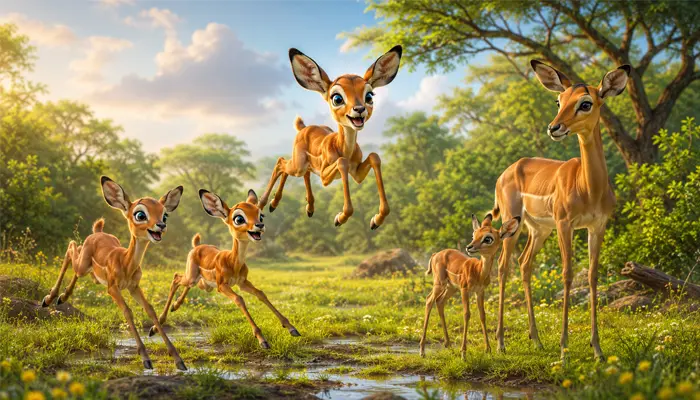
November is an exciting time in the bushveld because large numbers of impala lambs begin arriving shortly after the summer rains. The fresh grass gives their mothers better feeding conditions, but life in the wild does not allow much time for maternity leave.
A newborn impala may look delicate and slightly confused, but it must quickly learn to stand and follow its mother. Before long, the little lamb is bouncing through the grass on legs that appear to have arrived several sizes too large.
Young impalas often gather together in groups known as crèches, watched over by attentive females. It resembles a bushveld playgroup, except every child can sprint away at incredible speed when somebody shouts, “Lion!”
Their impressive leaps are not only playful. Impalas use high, energetic jumps to confuse predators and show that they are healthy enough to be difficult targets.
🌿 Baby Boom Fact: Impala mothers frequently give birth around the same period. The sudden arrival of so many lambs increases the likelihood that more of them will survive.
🐘 Baby Elephant’s First Trunk Trouble
One Trunk, Absolutely No Instructions
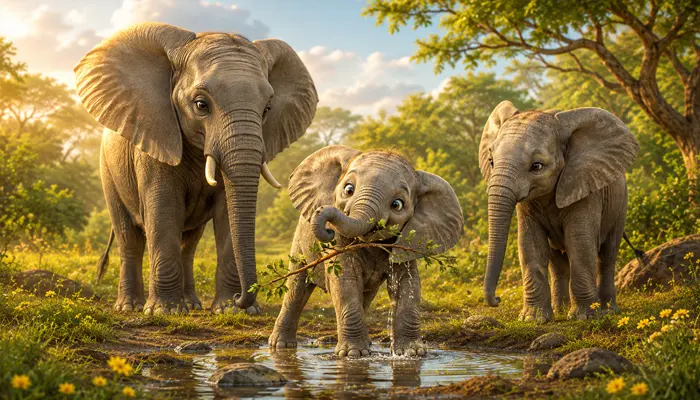
An elephant calf enters the world with an extraordinary multipurpose tool attached to its face. Unfortunately, nobody provides the instruction manual.
A young calf must learn how to control the thousands of muscles in its trunk. At first, the trunk may swing around, drag along the ground or end up somewhere completely unexpected. Picking up a small leaf can become a major engineering project, while drinking water is often easier when the calf simply puts its mouth directly into the pool.
Luckily, raising an elephant is a family project. Calves are protected by their mothers, aunts, sisters and other females in the breeding herd. Young females may act as allomothers, helping to guard, guide and comfort the newest member of the family.
The calf may be the smallest elephant in the herd, but it is surrounded by several tonnes of very serious babysitters.
🐘 Baby Boom Fact: Playing helps elephant calves develop movement skills, investigate objects and learn how to interact with other elephants.
🐗 The Warthog Express
Tiny Piglets, Maximum Speed
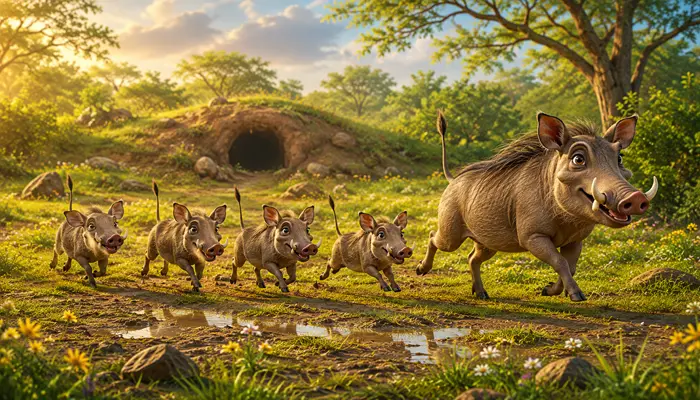
Warthog piglets may be small, but they are certainly not built for quiet mornings.
When danger appears, the entire family races towards the safety of its burrow with tails held straight up in the air. These raised tails act like little flags, helping the piglets follow their mother through long grass. It looks remarkably like a high-speed parade led by the bushveld’s most determined parent.
Warthogs commonly use abandoned aardvark burrows as shelters. Adults often enter backwards so their sharp tusks face the entrance, ready to discourage any uninvited visitor. The piglets remain safely behind Mum while she handles security.
The little ones spend their early days running, wrestling and copying everything the adults do. This includes kneeling on their front legs while feeding because warthogs have short necks and reaching the ground can be surprisingly inconvenient.
🐗 Baby Boom Fact: Several warthog piglets may be born in one litter. They remain close to their mother and quickly learn that the family burrow is the safest address in the neighbourhood.
🐣 Ostrich Dad’s Chaotic Day-Care
Too Many Chicks and Only Two Wings
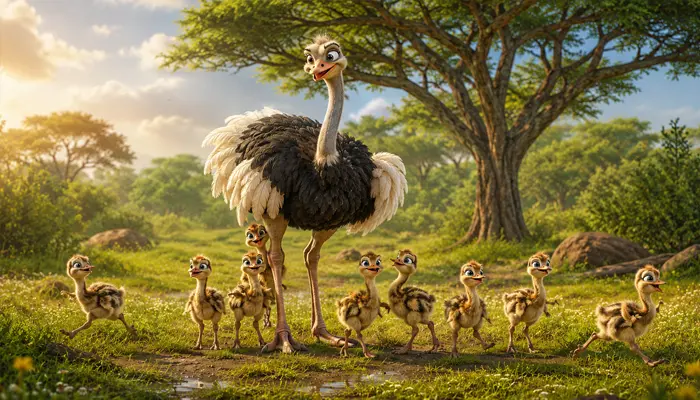
Somewhere in the bushveld, an ostrich dad is trying to count his chicks. He reaches twelve, somebody runs behind a bush and the entire process must begin again.
Ostrich parenting is a team effort. The dominant female usually lays her eggs in a shared nest, and other females may add their eggs too. The male and dominant female take turns incubating them. His dark feathers provide excellent camouflage at night, while her lighter colouring blends into the daytime landscape.
After the eggs hatch, the male often takes a major role in protecting and guiding the chicks. That is not a simple job when your children are striped, curious and capable of running in several directions simultaneously.
The tiny chicks follow closely behind their towering father, learning where to find food and when to hide. Anyone approaching the nursery should remember that an adult ostrich has powerful legs and takes its day-care responsibilities extremely seriously.
🐣 Baby Boom Fact: Ostrich chicks leave the nest shortly after hatching and follow their parents. Their brown-and-cream stripes help them blend into the surrounding vegetation.
🦓 Zebra Foal’s First Stripy Steps
Born with Its Own Barcode
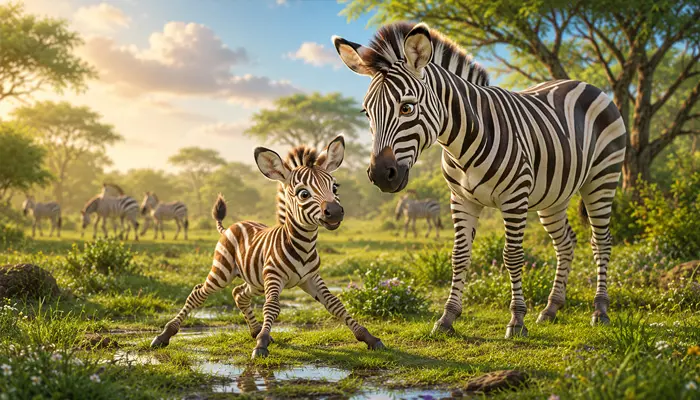
A newborn zebra foal arrives wearing one of nature’s most fashionable outfits. Its stripes may initially appear softer and more brown than black, but the pattern already belongs entirely to that individual.
Every zebra has a unique arrangement of stripes. Soon after birth, the mother stays close to her foal, allowing the youngster to learn her pattern, scent and voice. This helps them recognise one another when the foal eventually joins a herd filled with dozens of other stripy neighbours.
The little zebra must also learn how to stand and move quickly. Those wobbly first steps soon become playful kicks, sudden sprints and enthusiastic attempts to race animals with far more experience.
A herd gives the foal safety, extra eyes and plenty of potential babysitters. It also creates one small difficulty: finding Mum in a moving crowd that looks like somebody spilled an enormous box of barcodes across the bushveld.
🦓 Baby Boom Fact: Zebra foals stay close to their mothers during their early days and learn to recognise them through a combination of sight, sound and smell.
🌿 Welcome to the Wildest Nursery in Mzansi
The first summer rains bring more than green grass and dramatic thunderstorms. They introduce a brand-new generation to the bushveld, and every youngster has important lessons to learn.
The impala must run, the elephant must master its trunk, the warthog must remember the way home, the ostrich must follow Dad and the zebra must never lose sight of Mum.
They may be tiny, wobbly and occasionally covered in mud, but these little legends were born to be wild!