Nature's Dream Teams: Animals That Help Each Other Survive
South Africa is famous for extraordinary wildlife, but survival in the African bush is not always an individual effort. Some animals improve their chances by sharing the landscape with completely different species.
These unlikely neighbours may help one another find food, spot approaching predators or deal with irritating parasites. Some partnerships benefit both animals, while others give one species an advantage without causing any harm to the other.
Scientists use the word symbiosis to describe close relationships between different species. When both partners benefit, the relationship is called mutualism. When one benefits while the other is largely unaffected, it is known as commensalism.
That may sound very scientific, but the basic idea is wonderfully simple: different talents can work brilliantly together.
As South Africa celebrates Heritage Day on 24 September, these partnerships offer a fitting reminder of the strength found in diversity. From tiny birds riding on enormous mammals to mixed herds forming their own bushveld security network, meet five of nature's greatest dream teams.
🦏 The Tick Tacklers
Rhino & Oxpecker
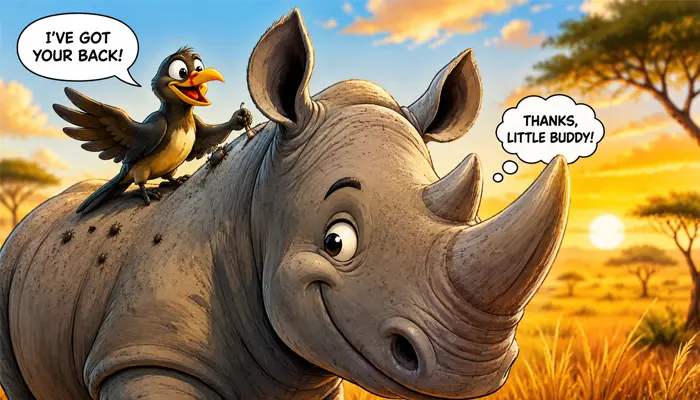
A small bird sitting confidently on the back of a massive rhino is one of Africa's most recognisable wildlife scenes. It may look as though the oxpecker has simply found the most impressive taxi in the bush, but there is much more happening.
Oxpeckers spend a large part of their day climbing across rhinos and other large mammals. Their specially adapted feet help them hold on while they search the animal's skin for ticks and other small creatures.
For the bird, the rhino can provide food, transport and a relatively safe place from which to watch the surrounding bush. The rhino may benefit when irritating parasites are removed from areas that are difficult for it to reach.
The oxpecker can also act like a tiny alarm system. Rhinos have poor eyesight, but oxpeckers are alert to movement around them. When something unfamiliar approaches, the birds may make warning calls or suddenly fly away, attracting the rhino's attention.
This relationship is more complicated than the simple story of a helpful bird cleaning its enormous friend. Oxpeckers may also feed on blood from existing wounds and can sometimes prevent wounds from healing quickly. Researchers therefore continue to debate whether the partnership is always helpful to the mammal.
Even so, the rhino and oxpecker remain an excellent example of the complicated relationships that develop between species sharing the same environment.
⭐ Team Stats
Heavyweight teammate: An adult white rhino can weigh more than 2,000 kilograms.
Featherweight teammate: An oxpecker weighs only around 50 to 60 grams.
Built for the job: Strong claws and a flattened body help oxpeckers cling to large moving mammals.
Special skill: Oxpeckers can alert poorly sighted rhinos to approaching people or predators.
Why this team works: The rhino provides a mobile feeding ground, while the oxpecker may offer parasite control and an extra set of eyes.
🦓 The Great Migrators
Zebra & Wildebeest
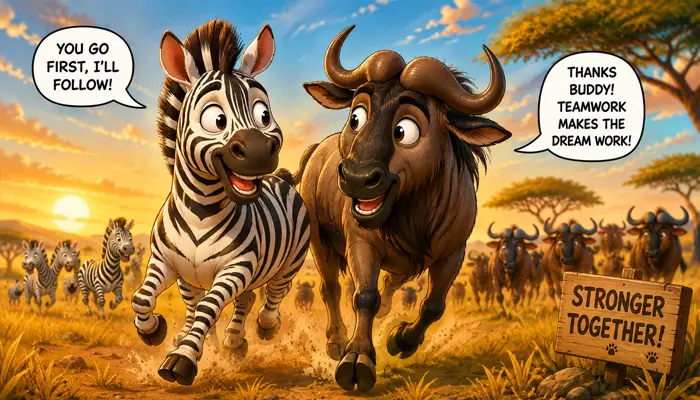
Zebras and wildebeest are regularly seen travelling and grazing together across Africa's grasslands. They may appear to be competing for the same food, but their dining preferences are surprisingly different.
Zebras are less selective grazers with strong front teeth that can crop taller and tougher grasses. Wildebeest generally prefer the softer, shorter grass that becomes easier to reach after zebras have grazed an area.
This means that both species can use different parts of the same grassland buffet. The zebras tackle the rough starters, while the wildebeest arrive for the more delicate second course.
Food is not the only advantage of staying together. A mixed gathering creates a much larger wildlife watch party. More animals mean more eyes scanning the horizon, more ears listening for unusual sounds and more noses testing the air.
Zebras and wildebeest also rely on slightly different senses and behaviours when detecting danger. When one animal becomes nervous or begins to run, the reaction can quickly warn the rest of the group.
A predator trying to approach such a gathering must avoid being noticed by hundreds of alert animals. Even after an attack begins, the large number of moving bodies can make it difficult for a lion, hyena or wild dog to isolate one target.
The partnership becomes particularly spectacular during the vast migrations of East Africa. South African zebras and wildebeest do not generally undertake the same enormous circular journey, but they can still be found feeding and moving together in local mixed herds.
⭐ Team Stats
First course: Zebras can feed on taller, tougher and less nutritious grasses.
Second course: Wildebeest favour shorter grasses and fresh green growth.
Security system: Mixed herds increase the number of animals watching and listening for predators.
South African sighting: Plains zebras and blue wildebeest are often seen together in savanna reserves.
Why this team works: Different grazing styles reduce direct competition, while larger mixed herds provide better protection from predators.
🦒 The Bush Lookouts
Giraffe, Zebra & Ostrich
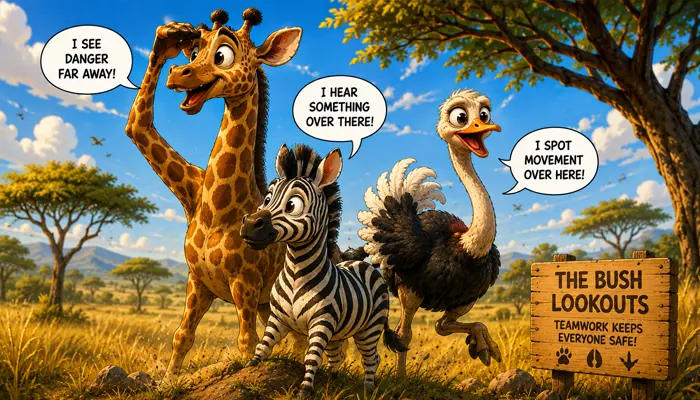
Imagine assembling a security team for the African savanna. You might choose one lookout with an unbeatable view, another with excellent hearing and a third with enormous eyes and impressive running speed.
Nature has already created exactly that combination.
Giraffes, zebras and ostriches may gather in the same open areas because each species brings different abilities to the neighbourhood watch.
A giraffe's extraordinary height gives it a commanding view over grass, shrubs and smaller animals. From that position, a giraffe may notice a distant lion or other disturbance before shorter animals can see it.
Nearby animals often pay attention to a giraffe's behaviour. When a giraffe suddenly stops feeding, stares in one direction or begins moving away, it can signal that something deserves attention.
Zebras contribute sharp hearing, a strong sense of smell and the alert behaviour of a social herd. Their mobile ears can turn towards different sounds, helping them notice suspicious movement even when tall grass limits visibility.
Then there is the ostrich. The world's largest living bird has exceptionally large eyes and excellent long-distance vision. Its height also provides a useful view across open terrain. When escape becomes necessary, powerful legs allow an ostrich to sprint away at remarkable speed.
The trio does not hold formal meetings or assign security shifts, of course. The benefit comes from simply feeding near animals that detect danger differently. Each species can observe the reactions of its neighbours and respond when the atmosphere suddenly changes.
⭐ Team Stats
Tallest lookout: A giraffe can reach approximately 5.5 metres in height.
Big eyes: Ostriches have some of the largest eyes of any land animal.
Listening post: Zebras can rotate their ears to investigate sounds coming from different directions.
Emergency exit: An ostrich's powerful legs make it one of the fastest animals on two feet.
Why this team works: Height, hearing, smell and long-distance vision combine to create a highly effective early-warning network.
🐘 The Grassland Sweepers
Elephant & Cattle Egret
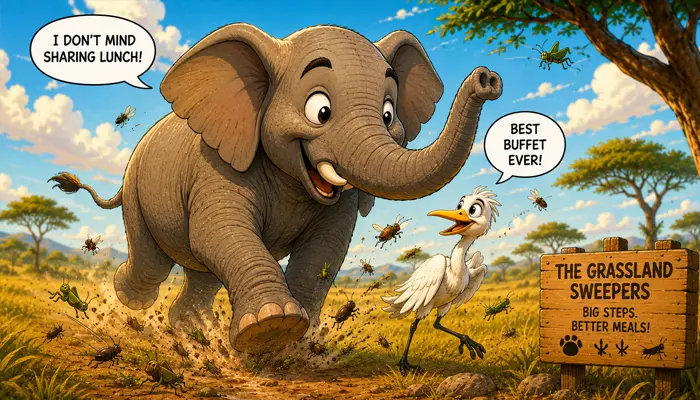
When an elephant walks through long grass, smaller creatures have a very difficult time remaining hidden.
Every enormous footstep and sweep of the trunk disturbs insects and other small animals resting among the vegetation. Grasshoppers jump, beetles move and frogs or lizards may rush away from the approaching giant.
For a cattle egret, this is not a disturbance. It is a food delivery service.
These elegant white birds often follow large grazing or browsing animals and quickly catch prey flushed out by their movement. Instead of searching through every patch of grass, the egret allows its much larger companion to do the difficult work.
The relationship is usually considered commensalism. The cattle egret receives a clear benefit in the form of easier access to food, while the elephant is neither significantly helped nor harmed.
Elephants are not the only mobile meal finders used by these clever birds. Cattle egrets may also follow buffalo, antelope, rhinos, livestock and even farm machinery.
It is an excellent strategy. When something large moves through vegetation, the egret knows there is a good chance that something much smaller will soon come racing out.
From the elephant's point of view, the bird is simply another neighbour going about its business. From the egret's point of view, however, the elephant is the biggest and most efficient grassland sweeper imaginable.
⭐ Team Stats
Big appetite: An adult African elephant can consume well over 100 kilograms of vegetation in a day.
Favourite snacks: Cattle egrets feed on insects including grasshoppers, crickets, flies and moths.
Efficient hunting: The birds position themselves close enough to catch prey as soon as it leaves the grass.
Flexible partnership: Cattle egrets also follow cattle, buffalo, antelope, rhinos and tractors.
Why this team works: The elephant's ordinary movement exposes hidden prey, giving the cattle egret an easier meal without affecting the elephant.
🐃 The Parasite Patrol
Buffalo & Oxpecker
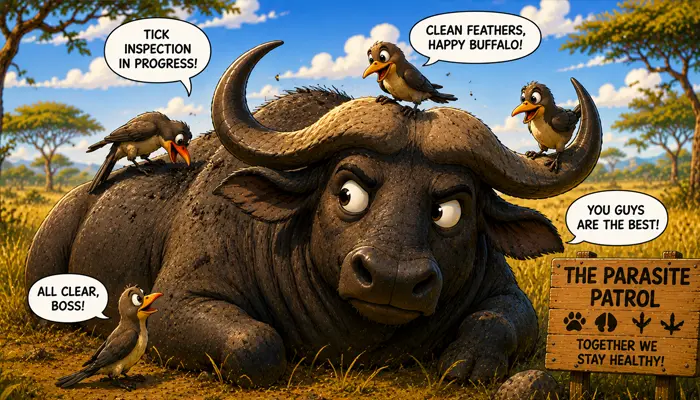
African buffalo have a reputation for strength, determination and an impressive ability to defend themselves. However, even one of the toughest animals in the bush can be bothered by something as small as a tick.
Fortunately, the buffalo has access to a patrol team that arrives with wings.
Oxpeckers regularly ride on buffalo and search through their hair for ticks and other food. The buffalo provides a large feeding area, while its herd offers the birds numerous possible hosts in one convenient location.
The birds inspect the buffalo's back, neck, head and other difficult-to-reach areas. They may even perch around the face and ears, showing very little concern about sitting centimetres away from a pair of enormous horns.
Like the relationship between oxpeckers and rhinos, the arrangement is not always as generous as it looks. Oxpeckers seek blood as well as parasites and may feed around wounds. Their behaviour can therefore shift between helpful parasite removal and a more self-serving meal.
Buffalo also use other methods to deal with pests. They wallow in mud, rub against trees and may tolerate different bird species around them. The oxpecker is one member of a much larger natural pest-management system.
The sight of several oxpeckers travelling on one buffalo perfectly suits the Dream Team theme. The buffalo supplies transport, protection and food, while the birds inspect places their host cannot easily scratch.
⭐ Team Stats
Powerful partner: A large African buffalo can weigh more than 700 kilograms.
Travelling restaurant: One buffalo may carry numerous ticks and other small creatures that interest oxpeckers.
Group opportunity: A buffalo herd gives the birds many potential feeding stops in the same area.
Important detail: The relationship is complex because oxpeckers can remove parasites but may also feed on blood from wounds.
Why this team works: Buffalo provide food and transport, while oxpeckers may remove some parasites from areas their hosts cannot easily reach.
What These Dream Teams Teach Us
Nature's partnerships are not agreements in the human sense. A zebra does not formally employ a giraffe as a lookout, and an egret never asks an elephant to walk through a particularly promising patch of grass.
These relationships develop because animals learn to take advantage of the abilities and everyday behaviour of other species. Over time, staying close to the right neighbours can improve access to food or increase the chance of noticing danger.
Some relationships are true examples of mutual benefit. Others favour one participant while leaving its companion unaffected. A few, such as the oxpecker's relationship with large mammals, can change depending on what the bird is eating and how its behaviour affects the host.
That complexity makes the African bush even more fascinating. Nature is not divided into completely separate stories. Every movement can create an opportunity for another animal, and every alarm can become useful information for nearby species.
Better Together This Heritage Day
Heritage Day celebrates the people, traditions, languages and experiences that contribute to South Africa's remarkable identity. It is a celebration of individual histories, but also of everything that becomes possible when different strengths share the same home.
South Africa's wildlife offers its own version of that lesson.
A tiny bird can become an alarm for a giant rhino. Zebras and wildebeest can use the same grassland without needing exactly the same meal. Giraffes, zebras and ostriches can create a security network simply by noticing one another's reactions. An elephant can help a hungry bird without even realising it.
These partnerships prove that nature's strongest team does not always consist of animals that look or behave alike. Sometimes, the most successful combination is built from completely different talents.
This 24 September, celebrate the diversity that makes South Africa extraordinary—and remember that across our plains, grasslands and game reserves, nature's dream teams are already showing us how powerful different strengths can be when they come together.