Funny April: Savanna Stand-Up
Welcome to the wildest comedy stage in South Africa.
This April, the bushveld becomes a stand-up arena. Each week, one brave animal delivers a classic joke to another, and then the real African wilderness reveals the deeper truth behind the punchline.
Because in the wild, the joke is only the beginning.
Episode 1: When the Lion Played Poker
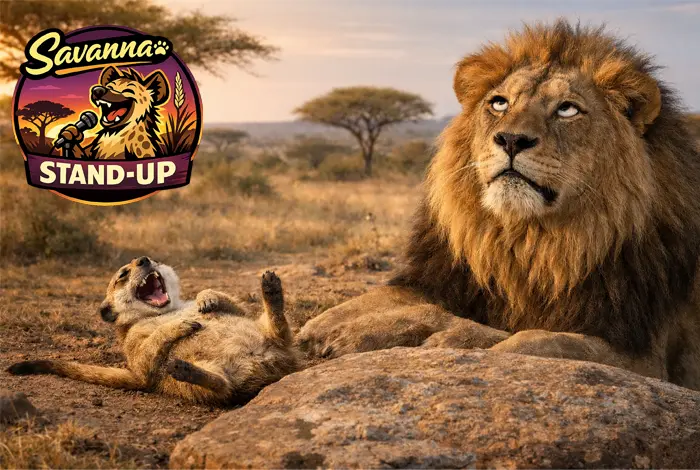
Late afternoon in the Kruger. A lion rests on a sun-warmed rock while a meerkat pops up from a nearby burrow and looks up with a grin.
The meerkat clears his throat.
Q: Why did the lion lose at poker?
A: He was playing with a cheetah!
It’s funny because the cheetah cheats. But in the real African wild, it is often the cheetah who loses everything.
Cheetahs are the fastest land animals on Earth, capable of reaching speeds of up to 120 km/h. Yet that explosive speed leaves them exhausted and vulnerable after a hunt.
And that is when lions frequently step in and steal the kill, a behaviour known as kleptoparasitism.
In poker, the cheetah cheats. In nature, the cheetah is often the one being robbed.
Speed may win the hand. Power clears the table.
Episode 2: The Elephant and the Mouse
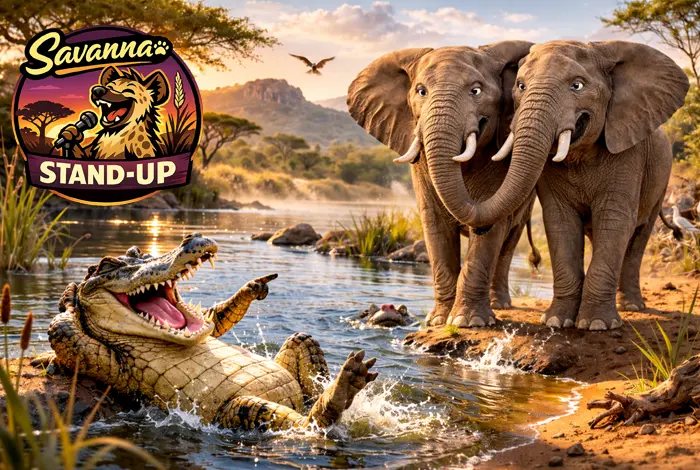
Morning mist hangs over a slow river. A crocodile floats silently as an elephant approaches the water’s edge.
The crocodile smirks.
Q: Why do elephants never use computers?
A: They’re afraid of the mouse.
The joke suggests fear, but the truth is different.
Elephants are not afraid of mice. However, they are highly sensitive to sudden movement. Their trunks contain tens of thousands of muscles, making them incredibly aware of what happens around them.
Weighing up to 6,000 kilograms, elephants survive through memory, social intelligence and awareness rather than intimidation alone.
Size creates presence. Awareness ensures survival.
Episode 3: The Rhino and the Stomp Sign
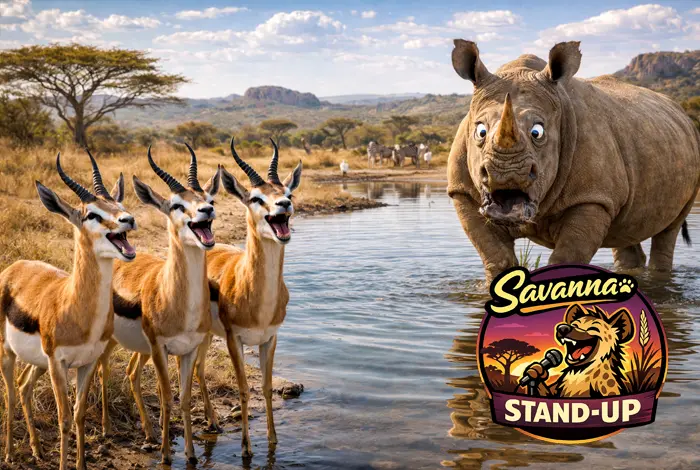
Heat shimmers across a dusty Karoo road. A springbok moves lightly across the open land while a rhino stands firm and immovable.
The springbok calls out playfully.
Q: Why did the Rhino get a ticket?
A: He ran through the stomp sign.
The pun may be light, but the power behind it is real.
Rhinos can weigh up to 2,500 kilograms and still reach speeds of nearly 50 km/h. When they charge, they commit fully.
Their eyesight is limited, so they rely on instinct and momentum. The springbok, by contrast, survives through agility, speed and the famous vertical leaps known as pronking.
Momentum pushes forward. Agility changes direction.
Episode 4: Never Argue with a Buffalo
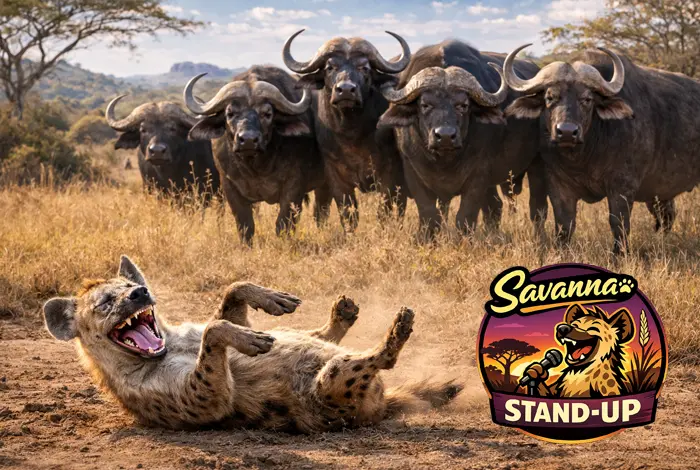
A herd of Cape buffalo moves slowly through tall grass while a hyena lingers at the edge of the clearing.
The hyena laughs nervously.
Q: Why don’t you argue with a buffalo?
A: Because they always charge.
This joke carries weight because Cape buffalo are part of Africa’s Big Five, known for their strength and unpredictability.
Weighing up to 900 kilograms, they are famous for explosive defensive charges and for protecting their herd members when threatened.
Buffalo do not seek conflict, but they will not retreat from it either.
Noise tests boundaries. Power defends them.
Episode 5: The Penguin Who Didn’t Fly
Cold Atlantic wind sweeps across Boulders Beach. An African penguin waddles confidently toward the sea while a hadeda calls loudly from above.
The hadeda delivers his joke.
Q: Why don’t penguins fly?
A: Because they’re not tall enough to be pilots.
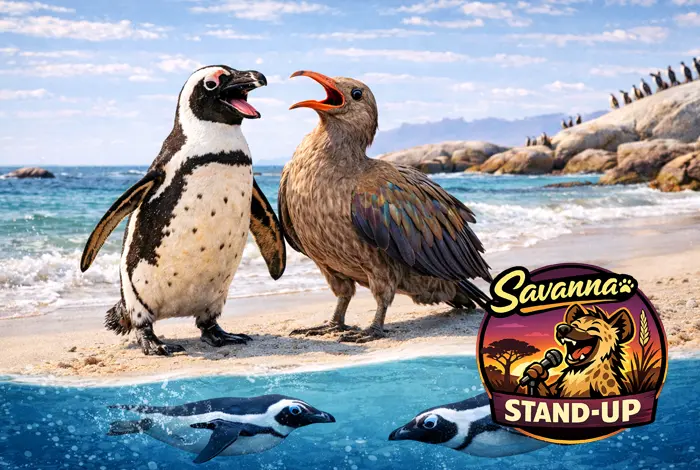
The punchline may raise a laugh, but it misses the point.
African penguins do not fly through the air. They fly underwater. With streamlined bodies and powerful flippers, they reach speeds of up to 20 km/h beneath the surface.
They did not fail at flying. They evolved for something different.
Not every strength looks the same. Adaptation beats imitation.
The Final Word from the Wild
Across the savanna, survival takes many forms.
Speed. Awareness. Momentum. Power. Adaptation.
Each animal plays to its strengths.
And in the wild, knowing how you are built is the greatest advantage of all.